

Fears of catastrophe as Greece puts migrant camps into lockdown
Doctors say coronavirus outbreak could be disastrous amid ‘horrific’ conditions
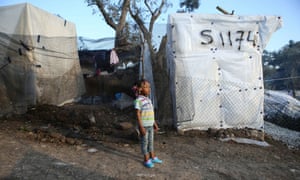
A child in a makeshift camp next to the official Moria migrant camp on Lesbos, Greece. About 20,000 people live in the Moria camp, which was built for 6,000. Photograph: Elias Marcou/Reuters
As the Schengen area closed its external borders last week, in a move designed to replace the closing of member states’ national borders against imported Covid-19 infection, some internal barriers still went up in Europe. The day after the European commission’s announcement, the Greek government introduced a set of measures that would apply to the migrant camps in the Greek islands.
As of Wednesday, the camps have been locked down from 7pm to 7am. In the daytime, only one person is allowed out per family, and the police control their movements. Some camps, on the islands of Leros and Kos, have been closed entirely.
Meanwhile, visits to the camps’ reception centres have been temporarily suspended, except for those who work there, and arrivals are being subjected to compulsory fever screening. The measures only apply to the camps, not to the resident population of the islands.

In the five Greek island “hotspots” that are sheltering about 42,000 people, one case of Covid-19 has been recorded. The affected person is a resident of the island of Lesbos. There have been no cases in the camps so far.
In Greece as a whole, 464 cases of Covid-19 have been recorded and six deaths. The government has banned mass gatherings and is urging Greeks to practise social distancing. Thirteen hospitals on the mainland have been turned over to the treatment of Covid-19.
“The imposition of this restriction of movement on the people of the camps and not for anyone else on the islands is unacceptable and discriminatory,” said Apostolos Veizis, director of the medical operational support unit for Médecins sans Frontières (MSF) in Greece. “You are locking children, women and men into severely overcrowded camps where the sanitation and hygiene conditions are horrific.”

The largest camp, Moria on Lesbos, is temporary home to about 20,000 people but was built for just over 6,000. In parts of Moria, there is one water tap for 1,300 people, one toilet for 167 people and one shower for 242 people.
Up to six people may be sleeping in 3 sq metres (32 sq feet), a quarter of the size of an average parking space. “They do not have enough water or soap to regularly wash their hands and they do not have the luxury of being able to self-isolate,” Veizis said.
Over a third of the migrants are children, just under a half of whom are unaccompanied. Their principal countries of origin are Afghanistan, Syria, Iraq, Palestine and the Democratic Republic of the Congo, and their average stay in the camp is between five months and a year.
There are already high levels of health problems among the migrants, due to the unsanitary conditions, and high levels of stress. Veizis calls the situation “a chronic emergency”. “If we had an outbreak in these camps, it would be disastrous,” he said.

The Greek National Public Health Organisation, which is responsible for health in the camps, did not respond to requests for comment. However, a European commission spokesperson, Ciara Bottomley, wrote in an email that the commission was funding the deployment of doctors and other medical staff to the hotspots. “The healthcare response in case of an incident on a hotspot island foresees first treatment at the local island hospital followed by air evacuation to one of the specialised hospitals in the mainland,” she went on.
Those measures appear to apply to local residents only. Since last July, all arrivals to the camps have been excluded from the Greek healthcare system. Three government-funded doctors are conducting vulnerability screening in Moria, but the only medical care is being provided there by NGOs and voluntary groups.
Veizis said MSF had been in contact with the government to discuss case management in the camps as part of the government’s evolving Covid-19 strategy, in case of an outbreak there.
Meanwhile, he fears the new regime will add to the migrants’ stress while fanning tensions between them and local residents. Violence directed at NGOs forced some of them to temporarily suspend operations this month.
The new measures, Veizis says, are just “one more element to pit the people of the islands against the asylum seekers”.
The Guardian will engage with the most critical issues of our time – from the escalating climate catastrophe to widespread inequality to the influence of big tech on our lives. At a time when factual information is a necessity, we believe that each of us, around the world, deserves access to accurate reporting with integrity at its heart.
Our editorial independence means we set our own agenda and voice our own opinions. Guardian journalism is free from commercial and political bias and not influenced by billionaire owners or shareholders. This means we can give a voice to those less heard, explore where others turn away, and rigorously challenge those in power.
We hope you will consider supporting us today. We need your support to keep delivering quality journalism that’s open and independent. Every reader contribution, however big or small, is so valuable.
theguardian.com
A child in a makeshift camp next to the official Moria migrant camp on Lesbos, Greece. About 20,000 people live in the Moria camp, which was built for 6,000. Photograph: Elias Marcou/Reuters
As the Schengen area closed its external borders last week, in a move designed to replace the closing of member states’ national borders against imported Covid-19 infection, some internal barriers still went up in Europe. The day after the European commission’s announcement, the Greek government introduced a set of measures that would apply to the migrant camps in the Greek islands.
As of Wednesday, the camps have been locked down from 7pm to 7am. In the daytime, only one person is allowed out per family, and the police control their movements. Some camps, on the islands of Leros and Kos, have been closed entirely.
Meanwhile, visits to the camps’ reception centres have been temporarily suspended, except for those who work there, and arrivals are being subjected to compulsory fever screening. The measures only apply to the camps, not to the resident population of the islands.
In the five Greek island “hotspots” that are sheltering about 42,000 people, one case of Covid-19 has been recorded. The affected person is a resident of the island of Lesbos. There have been no cases in the camps so far.
In Greece as a whole, 464 cases of Covid-19 have been recorded and six deaths. The government has banned mass gatherings and is urging Greeks to practise social distancing. Thirteen hospitals on the mainland have been turned over to the treatment of Covid-19.
“The imposition of this restriction of movement on the people of the camps and not for anyone else on the islands is unacceptable and discriminatory,” said Apostolos Veizis, director of the medical operational support unit for Médecins sans Frontières (MSF) in Greece. “You are locking children, women and men into severely overcrowded camps where the sanitation and hygiene conditions are horrific.”
The largest camp, Moria on Lesbos, is temporary home to about 20,000 people but was built for just over 6,000. In parts of Moria, there is one water tap for 1,300 people, one toilet for 167 people and one shower for 242 people.
Up to six people may be sleeping in 3 sq metres (32 sq feet), a quarter of the size of an average parking space. “They do not have enough water or soap to regularly wash their hands and they do not have the luxury of being able to self-isolate,” Veizis said.
Over a third of the migrants are children, just under a half of whom are unaccompanied. Their principal countries of origin are Afghanistan, Syria, Iraq, Palestine and the Democratic Republic of the Congo, and their average stay in the camp is between five months and a year.
There are already high levels of health problems among the migrants, due to the unsanitary conditions, and high levels of stress. Veizis calls the situation “a chronic emergency”. “If we had an outbreak in these camps, it would be disastrous,” he said.
The Greek National Public Health Organisation, which is responsible for health in the camps, did not respond to requests for comment. However, a European commission spokesperson, Ciara Bottomley, wrote in an email that the commission was funding the deployment of doctors and other medical staff to the hotspots. “The healthcare response in case of an incident on a hotspot island foresees first treatment at the local island hospital followed by air evacuation to one of the specialised hospitals in the mainland,” she went on.
Those measures appear to apply to local residents only. Since last July, all arrivals to the camps have been excluded from the Greek healthcare system. Three government-funded doctors are conducting vulnerability screening in Moria, but the only medical care is being provided there by NGOs and voluntary groups.
Veizis said MSF had been in contact with the government to discuss case management in the camps as part of the government’s evolving Covid-19 strategy, in case of an outbreak there.
Meanwhile, he fears the new regime will add to the migrants’ stress while fanning tensions between them and local residents. Violence directed at NGOs forced some of them to temporarily suspend operations this month.
The new measures, Veizis says, are just “one more element to pit the people of the islands against the asylum seekers”.
Since you're here...
… we have a small favour to ask. More people, like you, are reading and supporting the Guardian’s independent, investigative journalism than ever before. And unlike many news organisations, we made the choice to keep our reporting open for all, regardless of where they live or what they can afford to pay.The Guardian will engage with the most critical issues of our time – from the escalating climate catastrophe to widespread inequality to the influence of big tech on our lives. At a time when factual information is a necessity, we believe that each of us, around the world, deserves access to accurate reporting with integrity at its heart.
Our editorial independence means we set our own agenda and voice our own opinions. Guardian journalism is free from commercial and political bias and not influenced by billionaire owners or shareholders. This means we can give a voice to those less heard, explore where others turn away, and rigorously challenge those in power.
We hope you will consider supporting us today. We need your support to keep delivering quality journalism that’s open and independent. Every reader contribution, however big or small, is so valuable.
theguardian.com


Καλά αυτή η εγγλέζικη παλιοφυλλάδα που το έμαθε για την επικείμενη τραγωδία της νήσου Λέσβου;
ΑπάντησηΔιαγραφήΑφού ο τεχνοκράτης του σουπερ ΕΚΑΒ & άρχων του ΕΚΕΠΥ σιωπά;
Και καλά αυτός μπορεί να μην ξέρει αγγλικά ή να μην ευκαιρεί γιατί αυτό τον καιρό στήνει διάφορα ρεπορτάζ του κώλου.
Οι επιστήμονες του μαγαζιού δεν διαθέτουν ίχνος ντροπής;
Δεν ρωτάτε τον εισαγγελέα Λαρίσης μήπως έχει κανένα συμφοιτητή στην Λέσβο;
Καλύτερα πέστε στον Γούλα, να κάνει δηλώσεις που έχει και φωτογένεια. Ίσως έτσι ζηλέψουν και οι εργατοπατέρες Αθηνών & περιχώρων
ΑπάντησηΔιαγραφή